- Big Ramp Newsletter
- Posts
- Smokesignals
Smokesignals
Diego Juárez and Gianna Santucci

Big Ramp
March 23, 2026
March 28 - April 25, 2026
Opening Reception 6-9pm 3/28/26
BIG RAMP is thrilled to announce Smokesignals, featuring new work by Diego Juárez and Gianna Santucci, curated by Macy West.
Smoke signals are a highly effective means of visual communication across vast distances. The signals are tenuous and susceptible to breakdown, quickly dispersing as they reach a higher altitude, if the wind blows, or if the fire below is extinguished. A shape with no outline, they are an unbounded temporary density, the redistribution of matter from one form into another. A signal begins with clear intent, but as it continues to fold and shift, so does its meaning. Its success is dependent on the precise convergence of time and place.
Smokesignals, a two-person show of Gianna Santucci and Diego Juárez’s recent work, is a temporary density, a record of survival communicating across vast distances of time, material, and memory. Smokesignals circumvents broad universalities and the impulse toward substantive meaning in favor of passing motion, process and discontinuous partialities. It’s an acknowledgment of now, and yesterday, and tomorrow held together in a sort of singularity.
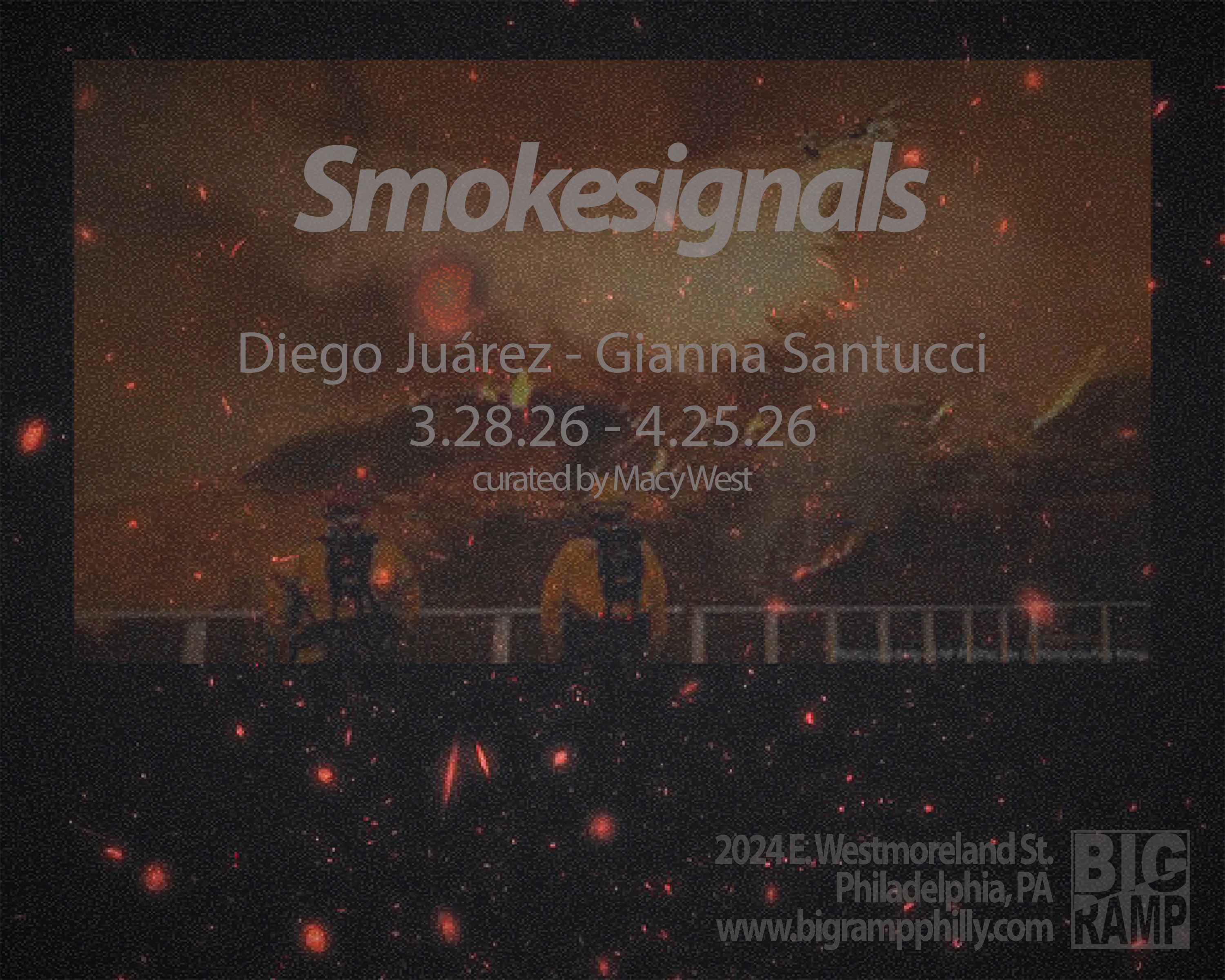
Juárez’s paintings are built around collaged grounds of image transfers from personal and public archives, images which twist and reconfigure themselves, fighting against the texture of the canvas and using that grain as another mark on the surface. Simultaneously additive and subtractive, they are unstable and net neutral. Digital imagery and the painted surface converge into a fractured, collaged space which heightens and probes the way our image culture reproduces subjects and runaway narratives. Deeply connected to his poetic writing practice, the paintings themselves are semanticly structured, mimicking the page and fragmented into line breaks and stanzas. Looking closely, the images reveal themselves as portraits of disaster zones like the 2025 Los Angeles wildfires and failing infrastructure in the urban landscape of North Philadelphia. Juárez’s abstract-pictorial world underscores these realities through the residue of industry, nature, and people.
Santucci’s installation condenses particles in motion through found objects, video and audio to build past the disaster zone motif into a mock escapist’s world. Audio like a Cold War Era Florida tourism ad and video of the Atlantic’s waves at sunrise are the sirens’ call away from the reality of contemporary collapse. A tiny foil satellite hangs from the ceiling, a reminder of new frontiers that would be claimed and colonized. Santucci drafts a go-bag list, lifting from her childhood’s survivalist family mentality: speculative fears derived from an echo chamber of right wing narratives. It’s a perpetual readiness to leave mirroring today’s neoliberal impulse to evacuate. Her archive sketches a foreshadowing of contemporary political chaos, yet requires the viewer to connect the dots. Santucci’s installation both defies American exceptionalism and refuses to provide an alternate fixed ideology.
Smokesignals demands the viewer's presence. The signal is amorphous. It must be felt, not just seen. The sound waves from Santucci’s Yeti cooler resonate in the no place/my place of Juárez’s paintings, images so familiar, the viewer could have scrolled past them on their own camera roll. The senses are affronted, but meaning must be made, delineated by the viewer. This inevitable variation is the heart of Smokesignals, harnessing abstraction to propose a visual and material reality, redistributing the viewer’s senses to make meaning out of the temporary density of audio and image. While images are held as a common language, each artists’ engagement varies. Smokesignals breaks the feedback loop of fixed representation, and requires the viewer to generate new connections.
Bios:
Diego Juárez is a visual artist, poet, and curator from San Pedro, CA, currently working in Philadelphia. He received his MFA from the Tyler School of Art and Architecture and his BA from the University of California, Irvine. His multidisciplinary practice spans painting, drawing, printmaking and sculpture. His work uses the language of landscape painting, incorporating poetics, abstraction, and material transformation to ask how existing identities and narratives can be reconstructed. His work has been exhibited across the United States.
Gianna Santucci is multidisciplinary artist and percussionist from Merritt Island, FL, currently based in Philadelphia. She received an M.F.A. in Painting at Tyler School of Art with a University Fellowship, and received a B.F.A. in Fine Arts and a B.M. in Music Performance from Florida Southern College. Her work has been recently exhibited in Icebox Project Space, Vox Populi, and Cherry Street Pier in Philadelphia. Recent performances include the ‘Low Tech Electronics Faire’ at the Charles Library and ‘Chilladelphia’ at Thunderbird Hall.
Macy West is a Philly-based painter and art educator making work exploring artistic and scientific visualization. In 2021 Macy completed her BFA in Studio Arts from Louisiana State University where she concentrated in Biological Sciences, exploring the intersection of art and science for visual communication. From 2021-2023, Macy taught high school art and physics at a private school in Covington, Louisiana, an experience which reinforced the importance of communication and learning to her artistic practice. Macy received her MFA Tyler School of Art and Architecture in Philadelphia, PA in May 2025. She is the co-editor of SENSUS Magazine.
|
